

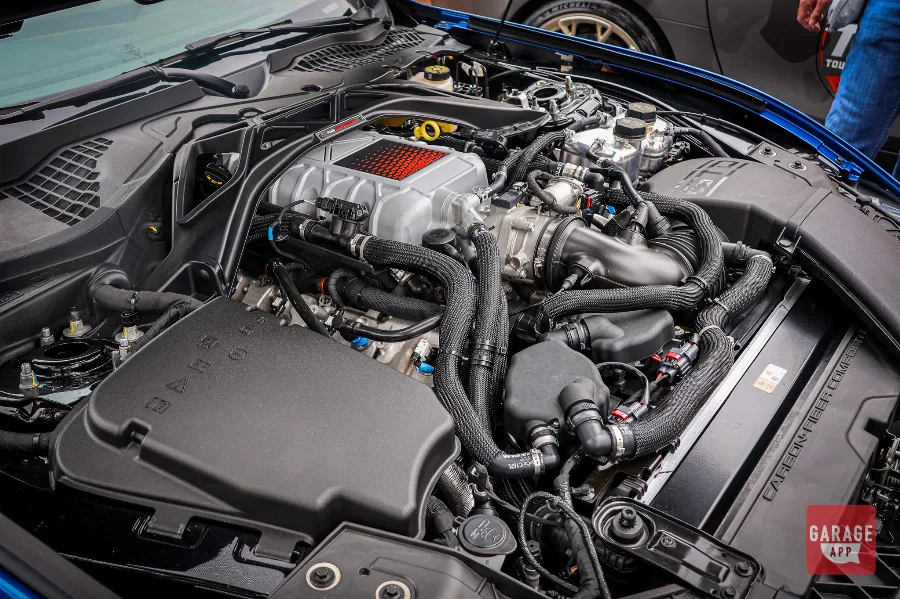
In the turbo vs supercharger debate, start with the plumbing. A turbo spins on exhaust energy, a supercharger is belt-driven off the crank, and a naturally aspirated engine breathes on its own. Forced induction makes more power per dollar, as the Porsche 911 Turbo S proves. NA usually wins on response and sound, which is why many manual transmission cars for 2027 skip boost.
Each choice also shapes what kind of car you end up living with. Gas mileage, heat management and how the engine behaves at a stoplight all change with it, along with how far you can push the build later. Below is how each approach works, how it feels from the driver's seat, and what we'd actually build.
Quick Comparison: Turbo vs Supercharger vs Naturally Aspirated
Before getting into the details, here's the short version. What is forced induction? It's any system that pushes air into the cylinders above atmospheric pressure. More air lets the engine burn more fuel, and more fuel means more power from the same displacement. Turbos and superchargers are the two main ways to do it.
| Trait | Naturally Aspirated | Turbocharged | Supercharged |
|---|---|---|---|
| Power source | Atmospheric pressure only | Exhaust gas spins a turbine | Belt or gear drive off the crankshaft |
| Throttle response | Instant and linear | Slight delay, much improved in modern designs | Instant, boost tied to engine speed |
| Efficiency | Good at light load, needs displacement for power | Best of the three, uses otherwise wasted energy | Weakest, takes power to make power |
| Sound | Loudest and most mechanical | Muffled by the turbine, plus whoosh and flutter | Engine note plus a distinctive whine |
| Complexity | Lowest | Highest: plumbing, heat, oil and coolant lines | Moderate, mostly bolt-on packaging |
| Tuning headroom | Limited and expensive | Largest, often unlocked with software | Good, pulley swaps add boost |
Naturally Aspirated: The Purist's Pick
A naturally aspirated engine fills its cylinders using nothing but the pressure difference created when the piston drops on the intake stroke. No pressurized air, no lag, no plumbing. The power you get comes from displacement, rpm and how well the engine breathes, so NA engineering is all about intake and exhaust flow, cam profiles and spinning higher.
The payoff is response. Squeeze the throttle and torque arrives in direct proportion to your foot, every time, at any rpm. Torque curves tend to be predictable, which makes NA cars easier to drive at the limit and easier to modulate mid-corner on a damp road.
The C5 Corvette Z06 is the American example worth knowing. Its 5.7-liter LS6 was a pushrod V8 that GM rated at 405 hp in its later years, and it did it with a simple, rugged design that still makes it a favorite swap engine. At the other extreme sits the Porsche 911 GT3, whose 4.0-liter flat-six revs to 9,000 rpm and makes 502 hp in the 992 generation. The two engines could not be more different in philosophy, yet both feel alive in a way most boosted engines don't.
Porsche itself is a good case study in this split. If you read our air-cooled vs water-cooled 911 guide, you'll see the company has run NA and turbo 911s side by side for nearly five decades, and the NA cars have always been the ones collectors chase for driving feel. Ferrari made the same call with the V12 in the 12Cilindri, which we compared against the last manual Ferraris.
The downside of NA is cost per horsepower. Bolt-ons like intakes and headers rarely add much on a modern NA engine because the factory already optimized them. Real gains usually mean cams, head work or more displacement, and that gets expensive fast.
Turbocharged: Efficiency and Huge Headroom
A turbocharger is two fans on one shaft. Exhaust gas leaving the engine spins the turbine side, and the turbine drives a compressor wheel that crams intake air into the engine. Because it's harvesting energy that would otherwise go out the tailpipe, a turbo is the most efficient way to make big power from a small engine. That's why turbocharging took over everything from pickups to hot hatches.
The classic complaint is lag. The turbo needs exhaust flow to spin up, so on older designs you'd press the throttle, wait, and then get hit with a wall of boost. The original 930 911 Turbo earned its widowmaker reputation partly because of this. Rally fans saw the same tradeoff in Group A cars like the one covered in our Lancia Delta Integrale buyer's guide, where anti-lag systems were developed to keep the turbo spinning between corners.
Modern turbo engines have mostly solved the problem. Twin-scroll housings, smaller twin turbos, variable turbine geometry and direct injection all help the turbo spool quickly. The 992.1 911 Turbo S uses variable-geometry turbos on its 3.8-liter flat-six and makes 640 hp with a response that feels closer to a big NA engine than a 1980s boost monster. BMW's twin-turbo 4.4-liter V8, covered in our 2020 BMW M8 Competition review, is another engine where most drivers would struggle to identify lag at all.
Heat is the real enemy. The turbine can glow red under load, and compressing air also heats it, so turbo cars need intercoolers, oil and coolant feeds to the turbo, and careful attention to oil quality. They also give up some sound, since the turbine muffles the exhaust. On the other hand, tuning headroom is enormous. Many factory turbo engines pick up serious power from an ECU tune alone because the manufacturer left boost on the table for durability and emissions margin.
Supercharged: Instant Boost and That Whine
A supercharger is an air compressor driven directly by the engine, usually by a belt off the crankshaft. Since it spins whenever the engine spins, boost arrives the moment you open the throttle. There's no waiting for exhaust flow. Roots and twin-screw superchargers deliver strong boost right off idle, while centrifugal units build boost with rpm and feel more like a turbo with no delay.
The tradeoff is parasitic loss. Driving the compressor takes horsepower from the crank, so a supercharger burns some of the power it creates just to run itself. That makes supercharged engines less efficient than turbos, especially at highway cruise, and it's a big reason manufacturers shifted toward turbos for mainstream cars.
For performance cars where efficiency matters less, supercharging is still the American muscle formula. The Ford Mustang GTD uses a supercharged 5.2-liter V8 rated at 815 hp. GM's 6.2-liter LT4 does duty in the Cadillac CT5-V Blackwing, where 668 hp pairs with an available six-speed manual. Both cars show the supercharger's best trait, which is a huge, predictable shove anywhere in the rev range.
A turbo makes you wait for the party. A supercharger is already dancing when you walk in.
And then there's the whine. Positive-displacement superchargers sing as they spin up, and plenty of owners consider that sound half the reason they bought the car. If you love a big V8 and want it to sound like a big V8, a supercharger keeps more of that character than a turbo does.
Twincharging and Electric Turbos
Some engineers decided to use both. Twincharging pairs a supercharger for low-rpm response with a turbo for top-end power. The Lancia Delta S4 rally car did it in the 1980s, Volkswagen used it on its 1.4-liter TSI, and Volvo ran a supercharger and turbo together on its Drive-E four-cylinder. It works, but it's complicated, and it never went mainstream.
The newer answer is electric assistance. An electric motor built into the turbo shaft can spin the compressor before exhaust flow arrives, killing lag while keeping turbo efficiency. Formula 1 has used a version of this for years, and Porsche brought it to the street with the 911 Carrera GTS T-Hybrid. Expect to see a lot more of it as hybrid systems spread.
Adding Forced Induction to Your Car: What It Really Takes
Here's where we commit to an opinion. If you own a car that's already turbocharged, tuning what you have is the best power-per-dollar move in the hobby. If you own an NA car and want a forced induction build, a supercharger kit is usually the easier, safer path for a street car, and a turbo is the better path if you want maximum power and can handle the fabrication. Either way, the turbo or blower is the cheapest part of the job. The supporting work is what costs you.
- Fuel system. More air needs more fuel. Expect bigger injectors, a higher-flow pump and possibly upgraded lines. A lean condition under boost can melt a piston in seconds.
- Engine internals and compression. Many NA engines run high compression ratios that don't tolerate boost well. Low-boost kits often run on stock internals, but stronger pistons and rods become necessary as boost climbs.
- Cooling. Plan for an intercooler, likely a bigger radiator, and an oil cooler if the car sees sustained hard use. Heat soak is the most common complaint on a first build.
- The tune. Ignition timing, fueling and boost control all have to be recalibrated. A professional tune is not optional, and a bad one will hurt the engine faster than any hardware failure.
- Drivetrain. Clutches, axles, differentials and transmissions were sized for factory torque. They are often the first thing to break after boost is added.
- Legal and emissions. In California and other states that follow CARB rules, look for kits carrying an Executive Order number for street legality.
Before you buy a kit, check whether your engine has a known boost-friendly sister version. Engines that also shipped with factory forced induction often share stronger parts, which makes your build simpler.
Classic owners should think about value too. Bolting a blower onto a vintage V8 turns the car into a restomod, so read our take on restomod vs original classic cars first. If the car is a rare survivor, our breakdown of numbers-matching vs clone vs tribute explains why keeping the original engine crated and safe can protect resale.
And if the goal is lapping, remember that boosted cars punish weak cooling on track far more than on the street. Budget for that as part of how much a track day costs, because the extra heat management is a real line item.
Track Your Build in GarageApp
Forced induction builds evolve in stages, and it's easy to lose track of which tune, pulley or injector size you were running when something changed. Logging each step in your GarageApp virtual garage keeps a clean history for you and for the next owner. Our guide to building your digital car garage walks through setting up a profile, adding photos and listing mods.
Post dyno sheets and parts lists to your GarageApp car profile as you go. Other owners running the same engine can spot problems early, and you'll have a record if you ever sell. New to the app? Start with what GarageApp is.
Our pick: build turbo if you want the most power and don't mind the plumbing, supercharger if you want instant torque and V8 character, and stay NA if throttle feel matters more to you than the number on the dyno sheet.
Comments (0)
Be the first to comment.
You need to be logged in to comment
Not a member yet? Join GarageApp to join the conversation.
Your comment has been sent!
Our GarageApp team will moderate your comment shortly.